


Bio-Blocks for Hotels: The “Set and Forget” Solution for Drain Maintenance
Imagine it is the height of wedding season. Your banquet hall is packed, the kitchen is firing on all cylinders across three simultaneous services, and then housekeeping radios in with the kind of message that makes every General Manager’s stomach drop: there is a drain backup near the lobby washroom, and something distinctly unpleasant is working its way toward the reception area.
Your maintenance team rushes over. Guests start noticing. And before the evening is out, someone has already typed something onto a review platform.
This is not a worst-case hypothetical. It is a scenario that plays out with uncomfortable regularity across Indian hotels, from business properties in Pune to heritage resorts in Rajasthan, especially during high-occupancy periods. And what sits at the root of most of these incidents is a problem that rarely gets serious attention until it becomes an emergency: the unchecked accumulation of Fats, Oils, and Grease, FOG, inside the drainage system.
If you are a General Manager, an F&B Director, or a facility management professional, this article, much like The Ultimate FOG Management & Septic Health Guide for Commercial Facilities, is written for you. Not to alarm, but to offer a genuinely better way of handling something your team is probably managing reactively right now. That better way is called a FOG Bio-Block, and the reason it matters is because it works while your team is busy doing everything else.
Why FOG Is a Bigger Problem in Indian Hotels Than Most Operators Realize

Indian commercial kitchens are, by their very nature, high-fat environments. The cuisine demands it. A full-service hotel kitchen preparing an Indian buffet alongside continental and Chinese stations will push through ghee, refined oil, coconut milk, dairy cream, and animal fat in volumes that few international benchmarks account for. Deep-fry stations, tawa sections, biryani preparation, and mithai production all contribute, and they all drain into the same system.
The issue is what happens after the oil goes down the drain. It does not disappear. It cools as it travels through the pipe network, sticks to inner walls, and gradually builds up into a dense, waxy layer that restricts flow, traps food solids, and creates the anaerobic conditions that produce hydrogen sulfide, the gas responsible for that unmistakable rotten-egg odor that no amount of air freshener will permanently fix.
Left unaddressed, this FOG layer thickens. Drains slow. Grease traps hit capacity faster than scheduled service intervals account for. And then, at the worst possible moment, a full house, a VIP check-in, a wedding reception, something backs up.
Manual grease trap cleaning is the conventional answer to this, and it works. But it only works at the moment of service. The interval between visits is always a window of risk, and in a busy hotel kitchen, that interval tends to shrink faster than the cleaning schedule expects. Add the contractor cost, the downtime, the chemical disposal compliance requirements, and the picture starts looking like a system that is perpetually catching up with itself.
There is a more intelligent approach.
What a Bio-Block Actually Does, and Why the Science Behind It Matters
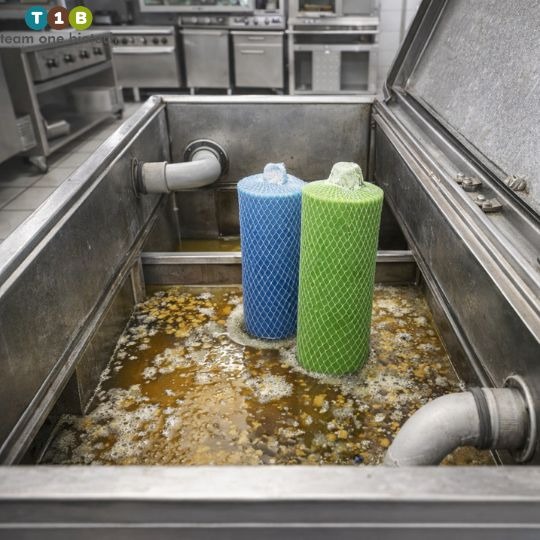
A FOG Bio-Block is a solid, slow-dissolving block packed with concentrated bacterial strains and enzymatic compounds. You place it inside or near the grease trap, wet well, or wastewater collection point, and it gets to work, quietly, continuously, without anyone having to manage it between placements.
The mechanism works in two coordinated stages:
- Enzymes move first. Lipase enzymes immediately begin breaking down complex fat molecules into shorter fatty acid chains. Think of this as pre-digestion, the FOG is made biochemically accessible before the bacteria even arrive.
- Bacteria do the sustained work. The released bacterial strains, aerobic and facultative anaerobic varieties, colonize the grease-coated surfaces inside the drainage system and continue metabolizing FOG into carbon dioxide, water, and minimal residual biomass. This is not a surface clean. It is a biological process that works through the buildup.
What makes this genuinely different from a chemical treatment is the slow-release matrix the block is built around. Rather than one sharp intervention followed by a return to baseline, the Bio-Block maintains a low, steady biological presence in the system, week after week, often for months depending on block size and drainage load.
This is bioremediation in practical application: the use of naturally occurring microorganisms to break down organic waste. The science has deep roots in industrial wastewater management and has been successfully adapted to the specific demands of commercial kitchen drainage maintenance.
Septic Tank Treatment: How to Eliminate Pumping and Foul Odors Permanently
While Bio-Blocks are famous for keeping kitchen lines clear, the same bioremediation principles apply to the most neglected part of a hotel’s infrastructure: the septic tank. Traditional maintenance usually involves reactive “pump-outs” once the system sludges up or begins venting foul gases near guest areas.
By introducing specialized biological treatments for Septic Tanks, you can effectively eliminate the need for frequent mechanical pumping. The high-concentration bacteria in these treatments aggressively break down solid waste and organic sludge, converting them into liquid and gas. This not only prevents the dreaded “overflow” scenario during peak wedding or holiday seasons but also neutralizes the sulfur compounds that cause odors. Instead of just hauling waste away, you are creating a self-sustaining ecosystem that digests waste permanently, protecting your ground sensors and drainage fields from clogging.
“Set and Forget”, What That Actually Means Day-to-Day
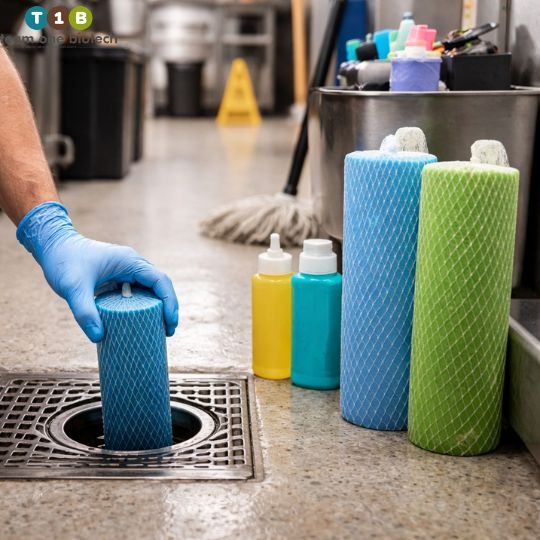
The phrase earns its place because it describes a real operational shift, not a marketing idea. Once a Bio-Block is deployed in your oil and grease trap, your maintenance team is no longer managing a problem on a crisis-driven timeline. They are sustaining a biological system that runs between human interventions, not because of them.
Here is what that looks like in practice:
- Fewer manual cleaning visits. Properties using Bio-Blocks typically report a reduction in professional grease trap cleaning frequency in the range of 30% to 60% over a 6 to 12-month period, depending on kitchen load and system configuration.
- Lower contractor and chemical costs. Fewer pump-out events mean fewer site visits, less chemical purchase, and less coordination overhead for your maintenance team.
- Persistent odor control. Because the biological process suppresses the anaerobic conditions that generate foul gases, the odor issue is addressed at its source rather than temporarily masked.
- Better pipe health over time. A drainage system that carries consistently lower FOG loads experiences less internal corrosion, fewer emergency blockages, and a meaningfully longer service life between major interventions.
For a General Manager who is tracking guest satisfaction scores and managing departmental cost efficiency at the same time, this is not a minor convenience. It is a structural change in how the property handles one of its most unglamorous but consequential systems.
Want to know what your property’s FOG load actually looks like, and which Bio-Block configuration makes sense for your setup? Reach out to Team One Biotech for a no-obligation site audit.
The India-Specific Challenges That Generic Solutions Often Miss
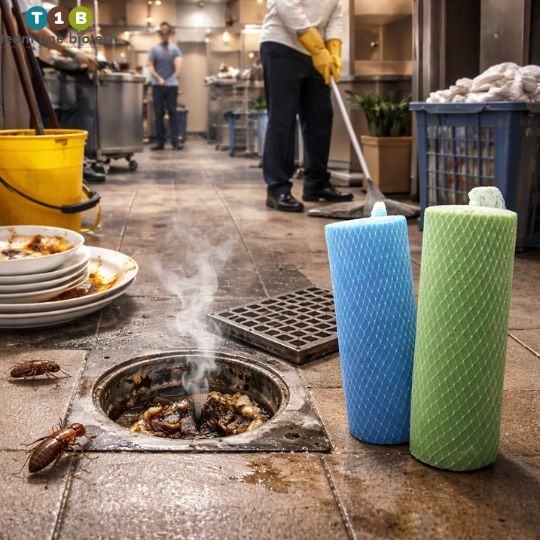
Products designed for Western markets are generally calibrated for lighter fat loads and more stable ambient temperatures. Indian hotel kitchens are a different operating environment, and it is worth being specific about why.
Temperature swings are more extreme. Kitchen drainage in India experiences high temperatures during service and significant cooling overnight. This thermal cycling accelerates the solidification of FOG on pipe walls in ways that are more aggressive than what temperate-climate formulations are designed to handle. Bio-Block products suited for Indian conditions need bacterial strains that remain active across a broad temperature range, typically 20°C to 45°C, without losing efficacy.
The FOG profile is more complex. A combination of hydrogenated vegetable oils, animal fats, dairy fats from paneer, khoya, and cream-based gravies, and coconut oil from South Indian preparations creates a layered, harder-to-degrade FOG matrix. Bacterial strain selection matters significantly here. Not all bioremediation products are formulated for this level of complexity.
Regulatory pressure is growing. Urban local bodies in Indian metro cities, and increasingly in Tier 2 cities, are tightening enforcement of effluent discharge norms under CPCB and SPCB guidelines. Hotels operating ETPs and STPs face periodic inspections, and a persistent FOG problem in the drainage system can quietly undermine effluent quality metrics downstream. Proper FOG management through Bio-Blocks directly supports cleaner influent entering treatment units, which helps maintain their biological health and supports ongoing compliance.
Traditional Chemical Cleaning vs. Bio-Block Bioremediation: A Side-by-Side Look
| Parameter | Traditional Chemical Cleaning | Bio-Block Bioremediation |
| Mechanism | Chemical dissolution (acid/alkali-based) | Biological degradation via bacteria and enzymes |
| Treatment duration | One-time per service visit | Continuous, weeks to months per block |
| FOG removal depth | Surface clearance, temporary effect | Deep metabolic breakdown of FOG compounds |
| Labor requirement | High, scheduled contractor visits | Minimal, periodic block replacement only |
| Odor control | Temporary masking effect | Addressed at biological source |
| Impact on pipes | Risk of long-term corrosion | Benign to infrastructure |
| Environmental profile | Chemical waste, disposal compliance burden | Biodegradable, environmentally aligned |
| ETP/STP impact | May disrupt biological treatment units | Supports downstream biological treatment health |
| Cost trajectory over 12 months | High and recurring | Decreasing as system stabilizes |
| Compliance alignment | Neutral | Supports CPCB/SPCB effluent discharge norms |
The above reflects general behavioral patterns across typical commercial systems. Specific outcomes will vary based on system configuration, kitchen load, and product application method.
What the First Twelve Months Actually Look Like
Setting realistic expectations here matters, because Bio-Blocks are not an overnight fix. They are a biological system, and biological systems need time to establish.
Months 1 to 2, Establishment. Bacterial colonies are finding their footing in the system. Early odor reduction is usually noticeable. Flow improvement is marginal at this stage. For properties with significant pre-existing FOG buildup, one professional grease trap cleaning session before deployment is often recommended, giving the biological system a cleaner baseline to build from.
Months 3 to 6, Active remediation. The biological film is now active across the system. FOG accumulation rate slows in a measurable way. Most properties see a clear reduction in drain complaints coming from the kitchen and housekeeping teams during this period.
Months 7 to 12, Maintenance equilibrium. The system is running in biological balance. Manual commercial kitchen drainage maintenance events are reduced to the minimum operationally or regulatorily required. Total drain maintenance cost over this period, compared against the same 12 months prior, typically reflects a net reduction in the range of 25% to 45%, depending on kitchen output and the baseline condition of the system.
For a hotel running breakfast, lunch, and dinner service across a 100-plus cover restaurant with active banquet operations, the absolute savings are meaningful. But factor in what a single drainage emergency during peak season actually costs, emergency contractor rates, potential guest compensation, the review platform fallout, and the return on investment argument becomes a much easier conversation.
Disclaimer
All performance ranges, timelines, and cost reduction estimates in this article are general informational values based on typical commercial kitchen and drainage system conditions. Actual results will vary based on kitchen output volume, existing pipe and trap condition, grease trap size and configuration, ambient temperature, water chemistry, and the specific parameters of your ETP or drainage network.
Team One Biotech recommends a professional site assessment prior to initiating any Bio-Block deployment. This content does not substitute for individualized technical consultation.
The Brand Protection Argument, Because Finance Understands This Language
A backed-up drain during peak occupancy is never just a maintenance failure. It is a guest experience event that lands on review platforms, travels through travel agent networks, and gets shared in the kind of informal channels that are genuinely difficult to manage after the fact.
India’s hospitality market is review-driven in a way that continues to intensify. A single high-visibility drainage incident during a busy period can have trailing effects on occupancy and achieved room rate that will cost far more than any annual drain maintenance budget. Framing septic tank treatment and FOG management as brand protection, not just a cost line, tends to land very differently in leadership conversations.
That reframe is accurate. And it is the one that tends to move the decision forward.
Talk to the commercial kitchen drainage specialists at Team One Biotech. We will help you identify the right Bio-Block formulation for your specific FOG profile, kitchen configuration, and drainage system. Request your consultation today.
Working with Team One Biotech
Team One Biotech supplies and supports FOG Bio-Block deployment for hotels, resorts, hospital kitchens, institutional catering operations, and facility management companies across India. Our technical team conducts on-site assessments, determines the right block type and placement strategy for your specific oil and grease trap configuration, and provides ongoing monitoring support throughout the deployment period.
We work with properties both on a project basis and through recurring maintenance contracts, which include scheduled block replacement, periodic system reviews, and compliance documentation support for ETP and STP operators managing regulatory reporting obligations.
Two ways to move forward: Contact us for a product inquiry to explore Bio-Block options suited to your property, or ask about our recurring maintenance contract program, a structured, cost-predictable approach to keeping your drainage system biologically managed without adding to your team’s internal workload.
The kitchen will always run hard. Guests will always arrive expecting a certain standard. The drainage system running quietly beneath all of it should never be what lets either of those things down.
Looking to improve your ETP/STP efficiency with the right bioculture?
Talk to our experts at Team One Biotech for customised microbial solutions.
Contact: +91 8855050575
Email: sales@teamonebiotech.com
Visit: www.teamonebiotech.com
Discover More on YouTube – Watch our latest insights & innovations!-
Connect with Us on LinkedIn – Stay updated with expert content & trends!